Tell us about the job
Takes about a minute. No obligation.
Sizing a mini-split in El Paso County starts with understanding how little the compressor actually works. Homes in El Paso County, CO run cooling in a single month of the year, July. A system that runs for only that window never builds up the wear patterns a contractor sees in hotter climates, but it does have to perform reliably the moment temperatures rise, with no gradual ramp-up. That puts the weight of the install on correct refrigerant charge and proper capacity matching from day one, because the compressor will not get a second chance to find its footing before the season ends.
Existing electrical service is where a mini-split installation in El Paso County gets decided. Half the homes in El Paso County, Colorado were built in 1989 or earlier (2020-2024 ACS 5-year). A house built in that era was wired for whatever system it originally ran, and that original system is almost certainly gone. The panel a contractor opens today was sized for a different load, and what it will actually support for a new mini-split has to be measured, not assumed from the age of the house or the breaker labels already on the box.
What a Mini-split Installation Puts in Your Home
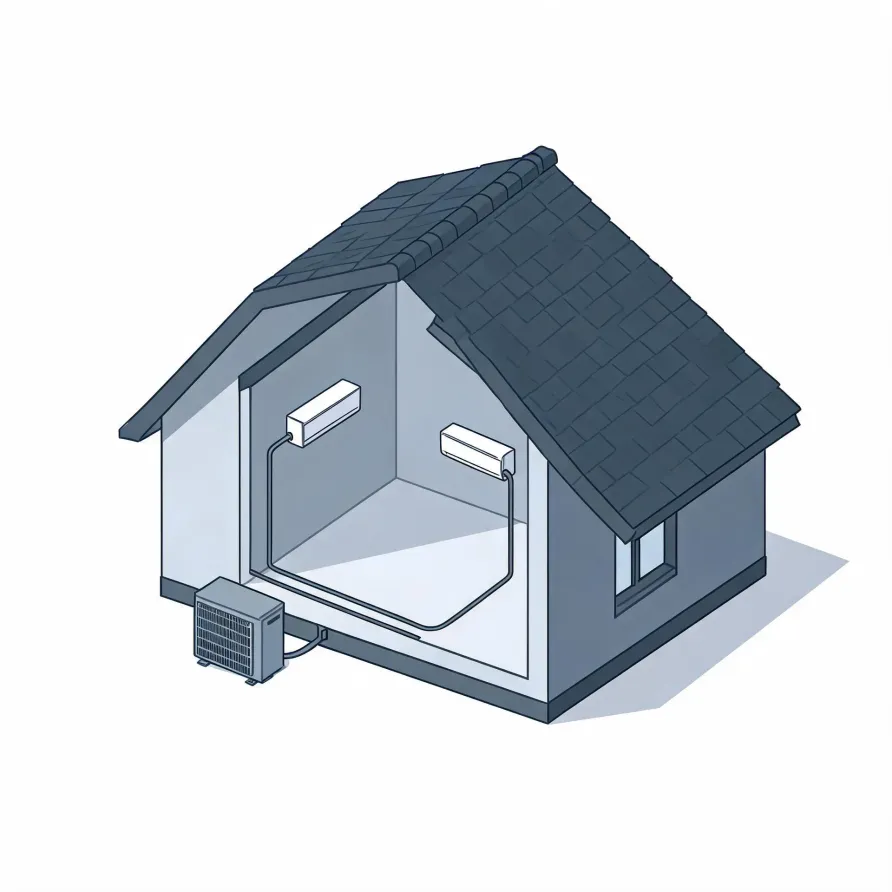
The indoor air handler mounts high on a wall inside the room being served, which is where most homeowners notice the system first. It pulls room air across its coil and delivers conditioned air back into the space. Some installations use more than one indoor unit, each serving a different room or zone.
The outdoor unit sits on the ground or on a wall bracket outside the house, and it carries the compressor and the condenser coil. A conduit of refrigerant lines, a power cable, and a condensate drain runs through the wall to connect the two units, and that conduit is the only penetration the system requires.
The drawing shows a typical layout, and a licensed contractor determines exactly what fits and where in your specific home.
Find a contractor in El Paso CountyEl Paso County, by the numbers
1,277 severe weather events were recorded in El Paso County, Colorado between 2015 and 2024.
NOAA National Centers for Environmental Information, Storm Events Database, bulk CSV export, events 2015-01-01 through 2024-12-31.Half the homes in El Paso County, Colorado were built in 1989 or earlier (2020-2024 ACS 5-year).
U.S. Census Bureau, 2020-2024 American Community Survey 5-Year EstimatesEl Paso County, Colorado holds 303,482 housing units (2020-2024 ACS 5-year).
U.S. Census Bureau, 2020-2024 American Community Survey 5-Year EstimatesOwners occupy 66.2% of the occupied homes in El Paso County, Colorado (2020-2024 ACS 5-year).
U.S. Census Bureau, 2020-2024 American Community Survey 5-Year EstimatesSevere Weather Events in El Paso County
El Paso County's climate puts real demands on heating and cooling equipment year-round. How hard a mini-split works, and how long it holds up, is a local question shaped by local conditions.
1,277 severe weather events, 2015–2023. Source: NOAA National Centers for Environmental Information, Storm Events Database.