

42°F dew point
That's the average dew point across a Colorado summer. Dry air like this puts less moisture load on your mini split, but dust and a dirty coil still cut its output hard.
Send the form and the mini split tune-up stops being something to remember.
I'm done searchingYou're probably asking because a tune-up sounds vague and you want to know what you're actually paying for before you book one. Maybe your mini split handled last summer's heat fine but you want to catch anything small before it turns into a repair bill, or someone mentioned a service and you want to know what they'd be doing to your system, not just what they'd be charging.
A mini split tune-up means a technician cleans the indoor air handler's filter and coil, checks the outdoor condenser for dirt and debris, and looks at the refrigerant lines and electrical connections. They'll check the drain line for clogs, since a blocked drain is one of the more common reasons these units stop cooling right. They'll also check that the unit is holding its charge and cycling the way it should. In Colorado, dust and cottonwood fluff build up on the outdoor coil over the summer, so clearing that is part of the job here. None of this is a repair. It's the maintenance that catches a dirty coil or a weak connection before it costs you a service call in July.
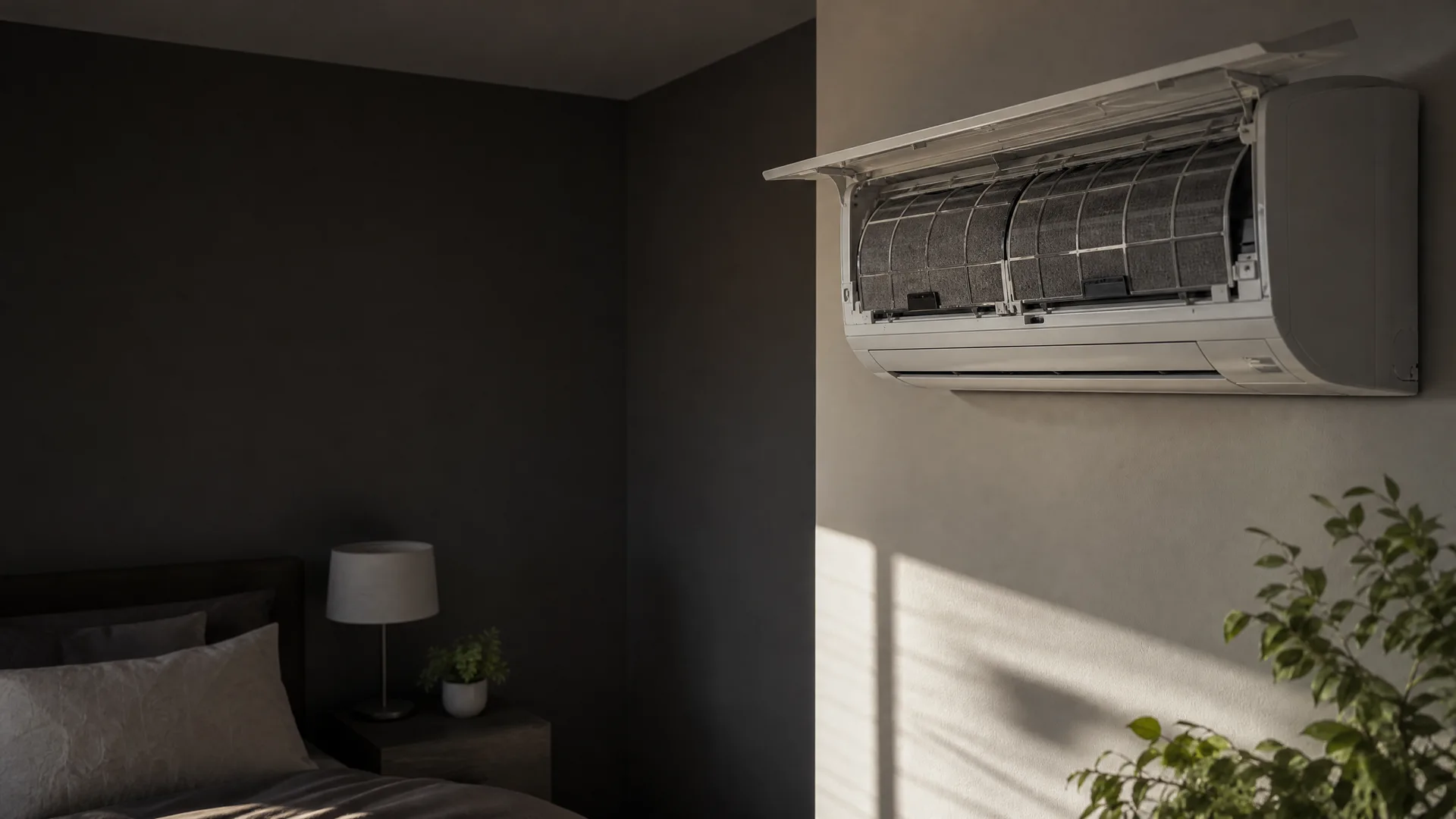
You pop the front cover off the indoor unit yourself, just to look, and the filter screen behind it is grey with a season of dust. It's one of those bright spring days before the real heat sets in, the kind that makes you think about getting ahead of it. Denver's sun has been coming through that bedroom window all afternoon, and the unit has sat quiet since the mild months started. You run a finger across the screen and it comes away dark. You think about August, about the unit pulling warm air through that same screen for weeks straight, and you set the cover down on the bed instead of snapping it back on. It can wait for someone who knows what else behind it needs a look before summer gets here.






A tune-up starts inside, at the wall unit. The filters come out first, then the coil cover, so the tech can see the evaporator coil itself. Dust on that coil acts like insulation, and it makes the unit pull more power to move the same heat. Next comes the condensate line. It runs from the indoor unit down to a drain outside, and if it's clogged, the water has nowhere to go but back up into the unit. After that the tech looks at the refrigerant line connections, right where the lines meet the indoor and outdoor units. Oily residue there usually means a slow leak, and catching it early means less refrigerant lost before it becomes a bigger problem. Outside, the condenser coil gets rinsed, since a season of dust and dry debris sits right on the fins that pull air across the compressor. Bent fins get flagged too, because even a few bent ones choke airflow around the unit. Every electrical connection, indoor and outdoor, gets checked and tightened. A loose one is a common reason a breaker trips for no clear reason, and left alone, it can damage the control board. Last is the blower wheel, tucked behind the filters. Dust cakes onto the blades unevenly, and an unbalanced wheel works harder and wears faster than one that spins true.


You've seen what's in a tune-up now, down to the coil and the drain line. What's left is finding someone to do it right, on a system that isn't like the gas furnace running the rest of your house. A mini split takes a different kind of knowledge, and the tech who services yours should be someone who works on these units all season in Colorado, not someone who sees one twice a year. Send the request and it goes to one local contractor who knows this equipment, not a handful of companies competing for your callback. That's one call to screen instead of five, one person who already knows what tends to fail on a mini split out here before they even look at yours. The dry heat this summer isn't waiting, and neither should the dust sitting in that filter. Send it off and let someone who knows this machine take it from here.

Colorado's dry heat hides something. Averaged across June, July and August, the dew point here sits around 42°F, a figure from NOAA climate data. That's low. Dry air like that means your mini split isn't fighting moisture the way one in a humid state would, so the coil inside the indoor unit stays drier too. Dust is the bigger threat here, not mildew. It builds on that dry coil and in the filter screen without the clumping damp air would cause, and a thin layer still cuts how much heat the coil can move. You'd notice it as the room taking longer to cool on the hottest afternoons, even with the thermostat set the same as always.
NASA POWER T2MDEW county cells weighted by homes
Notice if the room takes longer to cool than it used to, or if the air coming out feels weaker than you remember from last summer. Check for a hiss or a drip near the indoor unit, or water staining the wall underneath it. Look at the outdoor unit too. If leaves or dust have built up around it, airflow is already restricted. None of this stops the system from running, but it makes the compressor work harder to do the same job, and that's what shortens its life. Left alone through a Colorado summer, a dirty filter or a blocked drain line usually turns into a bigger repair, not a smaller one.


That's the average dew point across a Colorado summer. Dry air like this puts less moisture load on your mini split, but dust and a dirty coil still cut its output hard.
A local contractor who services mini splits all season knows the parts on yours that usually give out first, not just the gas furnace most Colorado homes run.
At 15.69 cents per kilowatt-hour, every bit of strain on your mini split shows up on the bill. A dirty coil or a clogged filter makes it run longer to hit the same temperature, and you pay for those extra minutes all summer.
EIA-861 2025 statewide residential average
A mini split tune-up in Colorado comes down to a handful of checks that matter more here than anywhere humid: the filters, the coil, the drain line, the refrigerant charge. Dry air keeps the moisture load low, but dust doesn't care about dew point, and a dirty coil will cut your output no matter what the sky is doing. You know what to ask for now, and what it should cost you in strain on the system and dollars on the bill if it gets skipped. The part still ahead of you is finding someone who works on this equipment regularly, not someone who services your furnace and treats the mini split as an afterthought. A local contractor who handles these year-round already knows which part tends to fail first on units that sit through a dry Colorado summer, and you'll be matched with one tech, not a handful of companies competing for your callback. That's the whole job from here: the system gets looked at by someone who knows it, and you go back to not thinking about it until next spring.
Finding a pro stops being your job