Tell us about the job
Takes about a minute. No obligation.
A contractor quoting a mini-split installation in Prowers County has to size the system for a concentrated cooling load, not a forgiving one. Homes in Prowers County, CO run cooling about three months a year, from June through August. The compressor carries almost all of that work in a tight window, which means an undersized unit runs at or near capacity through the bulk of its annual runtime rather than coasting through occasional warm spells. A load calculation that cuts corners gets exposed quickly. Contractors verify the thermal envelope, window area, and orientation before committing to a unit size, because those details determine whether the system holds the house or falls behind on the hottest afternoons.
Electrical service is where a mini-split installation in Prowers County gets decided, not the outdoor unit or the head. Half the homes in Prowers County, Colorado were built in 1971 or earlier (2020-2024 ACS 5-year). Wiring put in for the equipment of that era was sized for it, and a contractor assessing a job here checks the panel and the branch circuits before anything else gets quoted. If the service runs short, that work gets priced first. The equipment itself goes in after.
What a Mini-split Installation Puts in Your Home
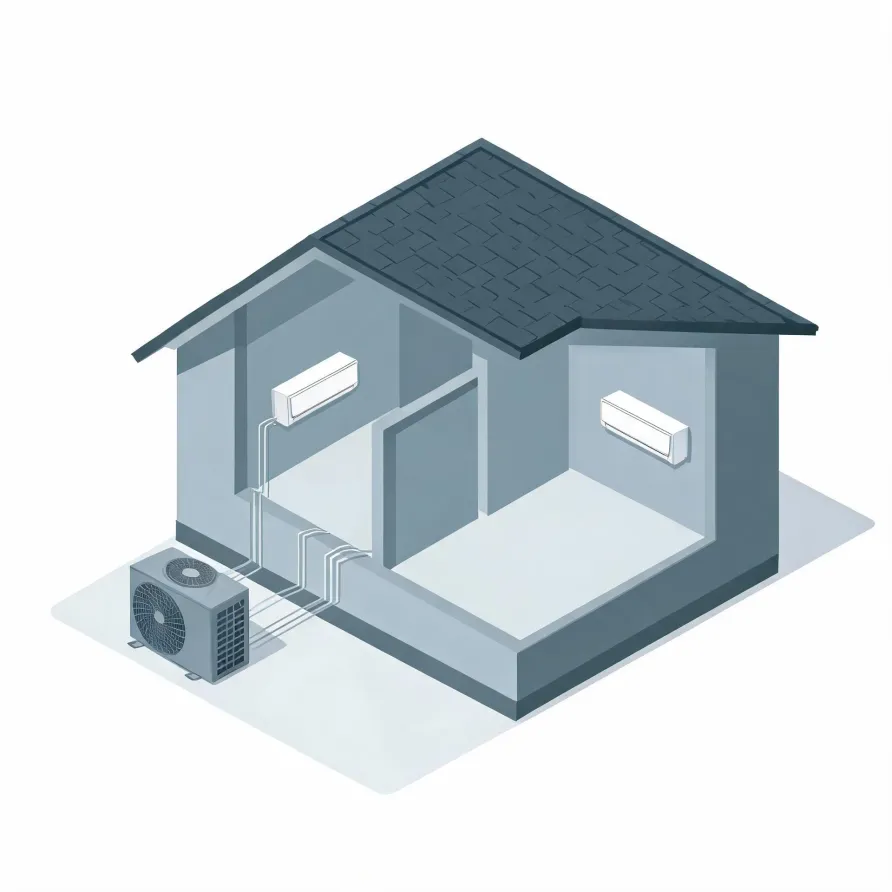
The indoor air handler mounts high on an interior wall inside the room being conditioned, and it is the piece a homeowner sees every day. The outdoor compressor unit sits on the ground or a pad outside the house and holds the components that drive the whole system.
A refrigerant line set runs through a small hole in the wall to connect the two units, carrying the working fluid between them. A condensate drain line runs alongside it, and a power cable ties the indoor unit back to the electrical supply.
The drawing shows the typical layout of these components, and a licensed contractor determines exactly how each one is positioned and routed in your home.
Find a contractor in Prowers CountyProwers County by the Numbers
271 severe weather events were recorded in Prowers County, Colorado between 2015 and 2024.
NOAA National Centers for Environmental Information, Storm Events Database, bulk CSV export, events 2015-01-01 through 2024-12-31.Half the homes in Prowers County, Colorado were built in 1971 or earlier (2020-2024 ACS 5-year).
U.S. Census Bureau, 2020-2024 American Community Survey 5-Year EstimatesProwers County, Colorado holds 5,479 housing units (2020-2024 ACS 5-year).
U.S. Census Bureau, 2020-2024 American Community Survey 5-Year EstimatesOwners occupy 67.1% of the occupied homes in Prowers County, Colorado (2020-2024 ACS 5-year).
U.S. Census Bureau, 2020-2024 American Community Survey 5-Year EstimatesSevere Weather Events in Prowers County
Prowers County weather puts real demand on heating and cooling equipment year after year. A mini-split sized and installed for local conditions holds up differently than one that was not, and this record shows what the equipment here is up against.
271 severe weather events, 2015–2024. Source: NOAA National Centers for Environmental Information, Storm Events Database.