


Profile view of a bearded man wearing a dark baseball cap and a dark gray T-shirt against a plain off-white background.

How cold is too cold for a mini split in Colorado

Step 1 of 3: Equipment

How cold is too cold for a mini split in Colorado?

You've got a mini split, or you're planning one, and Colorado winters make you wonder if it'll actually keep up once the temperature really drops. You're thinking ahead to next winter, not scrambling in the middle of a cold snap, so you want a real number, not a vague reassurance.

Most mini splits lose real heating power below 5°F, some hold on down to -13°F

Below freezing, a mini split still works, but the colder the air outside, the less heat it can pull from it. Standard units start struggling somewhere around 5°F. Cold-climate models, built with a different compressor, keep producing heat down to -13°F or lower. Front Range winters regularly drop well below freezing overnight, and mountain towns see stretches colder than that for days at a time. Since most homes here heat with gas, a mini split is usually there to carry the shoulder months and take the load off the furnace, not replace it on the coldest nights. Which unit you have, or plan to install, decides whether that matters at 10°F or at -5°F.

A white wall-mounted mini-split air conditioner indoor unit installed high on a plain beige wall near the ceiling.

Why cold air loses its heat

A heat pump pulls warmth out of the outside air and moves it inside. That works fine down to a point, because even cold air still holds some heat to grab. Below roughly 5 degrees, most mini splits start losing capacity fast, and the colder it gets past that, the less heat there is left to pull. That's not a defect. It's the physics every heat pump runs on, Colorado or anywhere else.

A white wall-mounted mini-split air conditioner unit near the ceiling of a plain white wall, with a gray curtain at the right edge and green plant leaves in the lower right corner.

What backup heat is doing

Mini splits paired with a furnace or baseboard heat usually have that backup switch on automatically once the outdoor unit can't keep pace. Some mini splits built for cold climates have a secondary heat strip inside for the same reason. Either way, the system isn't struggling along on its own once temperatures drop hard. The right size and the right model for your elevation and your winter lows decide how much of the season the mini split carries alone before that backup takes over.

A woman stands in the open black front door of a white-sided house with a dark shingled roof while a man in a navy jacket approaches along the walkway, with lantern wall lights, a potted shrub, and flowering garden beds nearby.

What this means for your place in winter

Most homes here already heat with gas, and that matters more than people realize when they're sizing up a mini split. If yours is backing up a furnace, a cold snap below 5 degrees just means the furnace carries more of the load that night. You won't notice much beyond a bill that shifts a little. If the mini split is your only heat, a stretch of single-digit nights is when you'd feel a room losing ground, usually the one farthest from the unit.

Either way, the question worth answering before next winter is whether the system you have, or the one you're looking at, was sized and chosen with that in mind. Not every mini split handles Colorado cold the same way, and a unit picked for a mild climate somewhere else will struggle here in ways a properly matched one won't. Getting that answer means finding someone who knows how these units perform at altitude and in a real Colorado winter, rather than guessing from a spec sheet or calling around to find out who even works on them.

A gray upholstered sofa with a beige cushion and knit blanket beside a curtained window, with a white mug and a book on a dark wooden table in the foreground and a lit lamp in the background.
A white wall-mounted mini-split air conditioner installed near the ceiling on a light-colored interior wall, with a window and green foliage visible at the left edge.

Running the way it should

A mini split that's sized and installed right keeps pulling heat out of cold air without strain. The unit stays clean, the coil behind the vents stays clear, and it can hold the room's temperature even as it works harder on the coldest nights.


A dusty white wall-mounted mini-split air conditioner indoor unit installed high on a beige interior wall below a white ceiling and trim.

Running into trouble

Dust and grime built up on the vents and intake grille choke airflow before the cold ever gets a chance to. A unit fighting through that has less capacity to spare once temperatures drop, and a Colorado winter will find that weak point fast.

A wall-mounted mini-split air conditioner indoor unit with a yellowed plastic casing and dark horizontal vent louvers, installed on a plain light-gray wall.
Before you get your mini split installation
A white wall-mounted mini-split air conditioner on a light gray wall in an empty room with dark wood flooring, white baseboards, a tray ceiling with recessed lights, and a window at the left.
After you get your mini split installation

Rely on the mini split alone through a hard freeze, and you're asking it to do the one thing it struggles with most. Capacity drops as the air gets colder, right when you need the most heat out of it.

Pair it with your furnace for those stretches and let each one do what it's built for. The mini split carries the mild days, the furnace takes over when it's below 5, and neither one is straining.

A woman with long gray hair wrapped in a checked blanket sits on a sofa by a window with yellow autumn foliage outside, with a lamp, framed picture and plant in the background.
An older woman in a cream knit sweater sits on a sofa by a window, looking out at sunlit trees with yellow and orange autumn leaves, with a bookshelf and lamp behind her.
A woman with gray shoulder-length hair in a dark knit sweater sits on a cushioned seat by a window, looking out at yellow autumn foliage, with a living room, armchair, houseplant and framed picture behind her.
An older woman with gray hair in a bun, wearing a cream knit sweater, sits on a sofa with a gray blanket and looks out a large window toward yellow-green autumn trees, with a lit table lamp and dark armchair behind her.

A mini split pro near you

Skip the round of in-home estimates for a new mini split.

Sending the form costs nothing.

How a mini split handles cold

  • Most mini splits run a variable-speed compressor that slows down or speeds up instead of switching fully on and off.
  • Below roughly 5 degrees, the defrost cycle kicks in more often, melting frost off the outdoor coil before it can keep pulling heat.
  • Each defrost cycle pauses heating for a few minutes while the system reverses and sends warm refrigerant to the outdoor unit.
  • The indoor head reads the room's temperature constantly and adjusts refrigerant flow rather than just cycling the blower on and off.
  • A unit rated for cold climates uses a larger compressor and an enhanced vapor injection circuit to keep capacity up longer as it gets colder.
  • The outdoor unit's fan has to keep spinning through the cold to pull enough air across the coil, which is why placement and clearance matter.

A mini split doesn't run like a furnace, full blast until it hits the setpoint, then off. The compressor is variable-speed, so it ramps up and down to match what the room needs. That's part of why it can feel different from the gas heat you're used to. The indoor head is reading the room's actual temperature the whole time and adjusting refrigerant flow to match it, rather than just kicking the blower on and off.

The harder part happens outside. As the outdoor coil pulls heat from the air, frost builds up on it, and once it gets cold enough, that frost forms faster than the unit can shed it on its own. So the system runs a defrost cycle: it reverses briefly, sends warm refrigerant out to the coil, melts the frost, then switches back. Each cycle only takes a few minutes, but heating pauses while it happens, and below roughly 5 degrees those cycles get more frequent.

This is where the equipment itself starts to matter. A unit built for cold climates has a bigger compressor and an enhanced vapor injection circuit, which keeps it pulling more heat out of that same cold air instead of losing capacity as fast. None of it works, though, if the outdoor fan can't move enough air across the coil, which comes down to where the unit sits and how much clearance it has around it.

A white wall-mounted mini-split air conditioner unit installed high on a light gray interior wall below crown molding, with a bamboo-shaded window at the lower left.
Here the mini split is keeping up, pulling heat steadily on a normal cold day without any strain on the system.
A wall-mounted mini-split air conditioner indoor unit with a dusty, discolored cover, installed near the ceiling on a plain light-colored wall.
Here the unit is coated in dust and buildup, the kind of neglect that cuts capacity right when a cold snap needs all of it.
A two-story house with beige horizontal siding, stone veneer at the base, dark shingled gable roofs and a concrete walkway leading to the front door, set behind a patchy green lawn under a clear blue sky.

Your mini split's winter trouble isn't really about summer, but summer tells you something about the air it has to work with. Across June, July and August, the dew point here averages 42°F, according to NOAA climate data, which is dry air compared to a lot of the country. Dry air cools easily and gives up its moisture fast, so your mini split isn't fighting humidity the way it would somewhere muggier. That's part of why summer cooling here is the easy season for it. Winter is the opposite problem. Once the air outside turns cold and thin, there's less heat in it for the unit to pull from, and that's where it starts to strain.

NASA POWER T2MDEW county cells weighted by homes

A woman in a cream knit sweater sits in an armchair with her eyes closed and head tilted back, beside a window showing orange autumn foliage and a wooden side table with a mug.
A gray-haired man in a blue quarter-zip sweater sits in an armchair with his eyes closed, beside a large window with bare trees outside and a potted plant and lamp nearby.

The answer stays the same no matter how many times you run the numbers: somewhere around 5 degrees, a mini split stops being enough on its own, and pairing it with your furnace is what carries a Colorado winter. That's not a flaw in the equipment, it's just the limit of what a heat pump can pull from cold air. Where you stand once you know this is a straightforward place. The unit needs to be sized for your place and installed so it can hold up when temperatures drop, not just on the mild days. Getting there usually means finding a contractor, checking who's licensed, calling a few, explaining your setup more than once, and sorting through quotes that aren't quite comparable. You can skip that part. Instead you get matched with a contractor who works on mini splits in Colorado and already knows what a hard freeze asks of one, and they reach out to you directly. What you do with that is still your call.

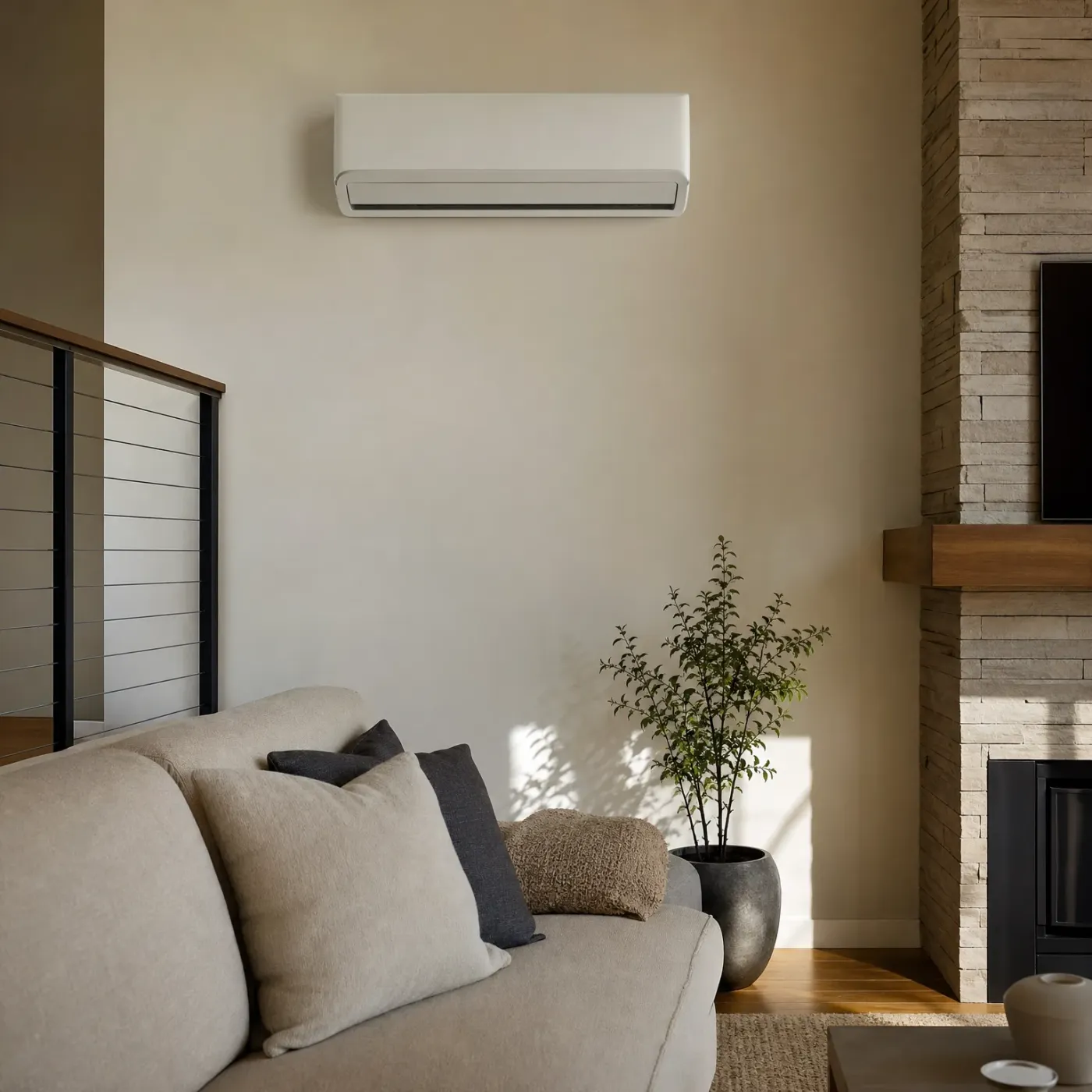
Interior living room with a white wall-mounted mini-split air conditioner high on a beige wall, a light gray sofa with cushions, a potted small tree, a stacked-stone fireplace with wood mantel and mounted TV, and a cable railing at left.

A local pro for your mini split installation

Get a local pro

Describe the project once instead of to every installer.

You're not committing to anything by asking.